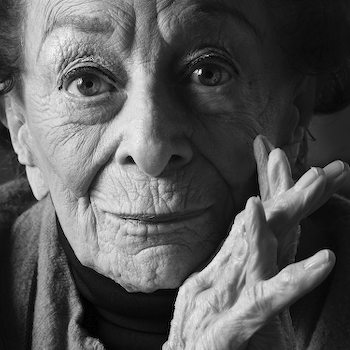
Ruth Bernhard, photographed by Rene de Carufel
Three days before the Godfather of Soul died on Christmas Day (requiescat in pace, James), we lost the woman we might call the "Godmother of Soulful Photography," Ruth Bernhard. The photographer, who died on December 22, at the age of 101, was certainly as talented--and every bit as transgressive--as the limber-legged showman. At a time when women rarely had careers, Bernhard created a notable one for herself. A lesbian and photographer in Twenties and Thirties Manhattan, she surrounded herself with others of like mind and talent, notably Berenice Abbott, and focused almost exclusively on the female nude in her work.
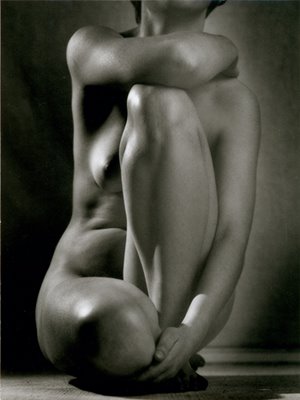
Ruth Bernhard: Classic Torso, 1952
"When I am in the studio, I am a sculptor with light. I want the nudes in my photographs to be like sculptures, an abstraction of the body, of the physical."
In 1948 she moved to San Francisco with her partner Eveline Phimister, in part to be near her mentor Edward Weston in his last years. She drew from her community some of the most iconic images she would create. My favorite is Two Forms, which she photographed in 1963. Everything about this couple in the photograph is in perfect equipoise: the line of the torsos flowing along parallel paths; the curve of breast and buttocks; the light hand against the dark back, dark shadows against white skin, light creating luminous contours on black skin--and as a result of this light and shadow, places on the two bodies where the skin tones are exactly the same.

Ruth Bernhard: Two Forms, 1963
"Men have photographed the female nude as if she belonged to them. I photograph a woman as part of the universe."
Later in the Sixties she would meet a man--younger than she, black--and begin a relationship that would last 30 years until his death in 1999. Photographs in Ruth Bernhard: Between Art & Life, by Bernhard and Margaretta K. Mitchell, show Bernhard surrounded by her partner Price Rice, and by friends and colleagues from all her worlds: artists and family, couples and singles, gay and straight, in all ages, colors and ethnicities.
Bernhard spent the last decades of her life teaching photography and being a mentor to many. "My last exposure was in 1976," she said in Between Art & Life. But, of course, her pictures live on.
 Ruth Bernhard: One World, 1946, above; Lifesavers, 1930